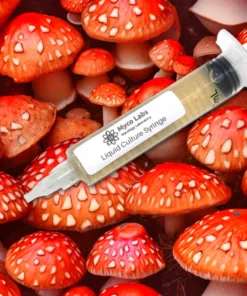
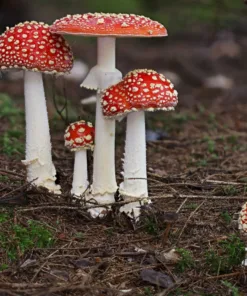

Shop Amanita Muscaria (Fly Agaric) Liquid Culture Syringe Online
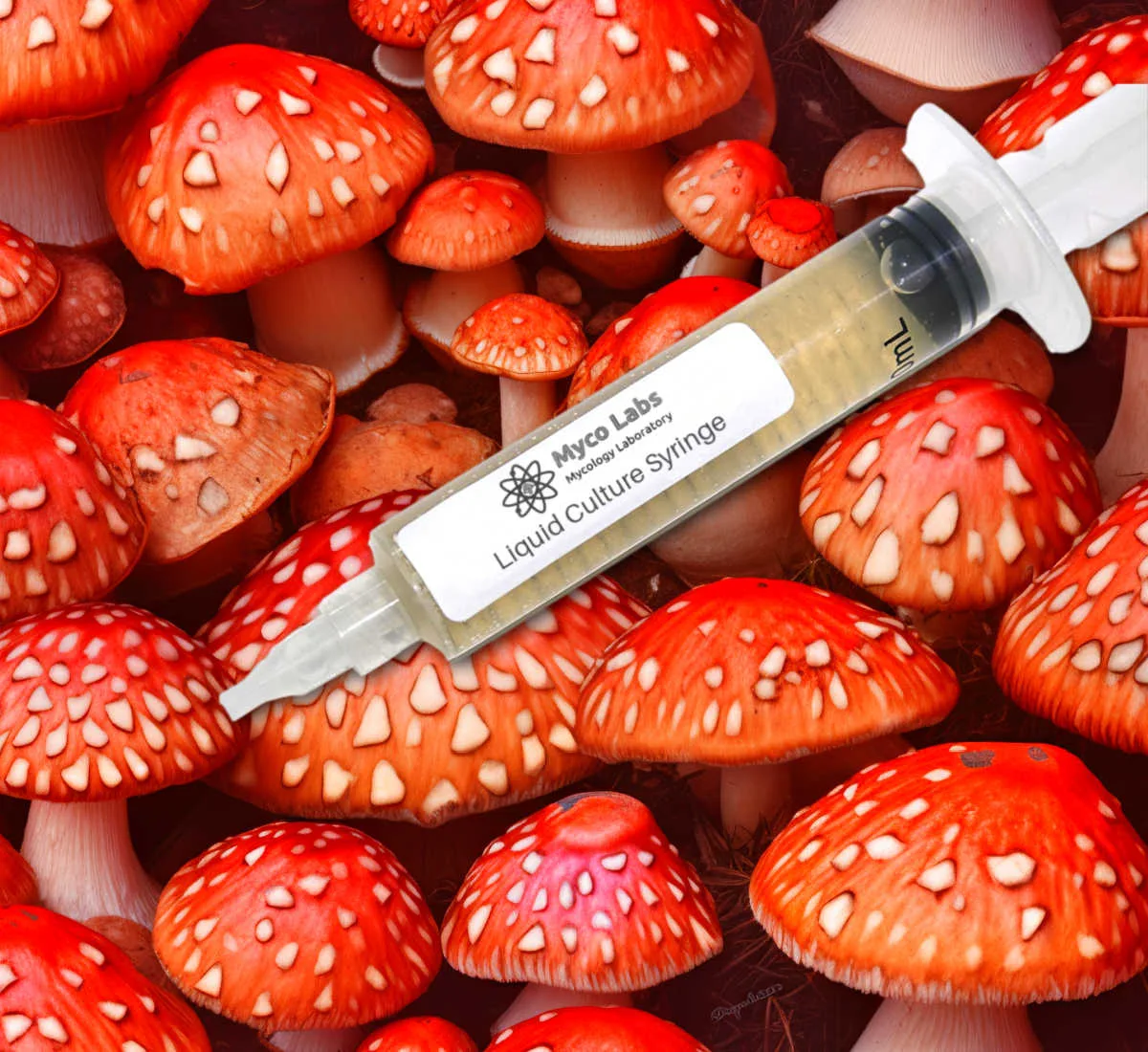
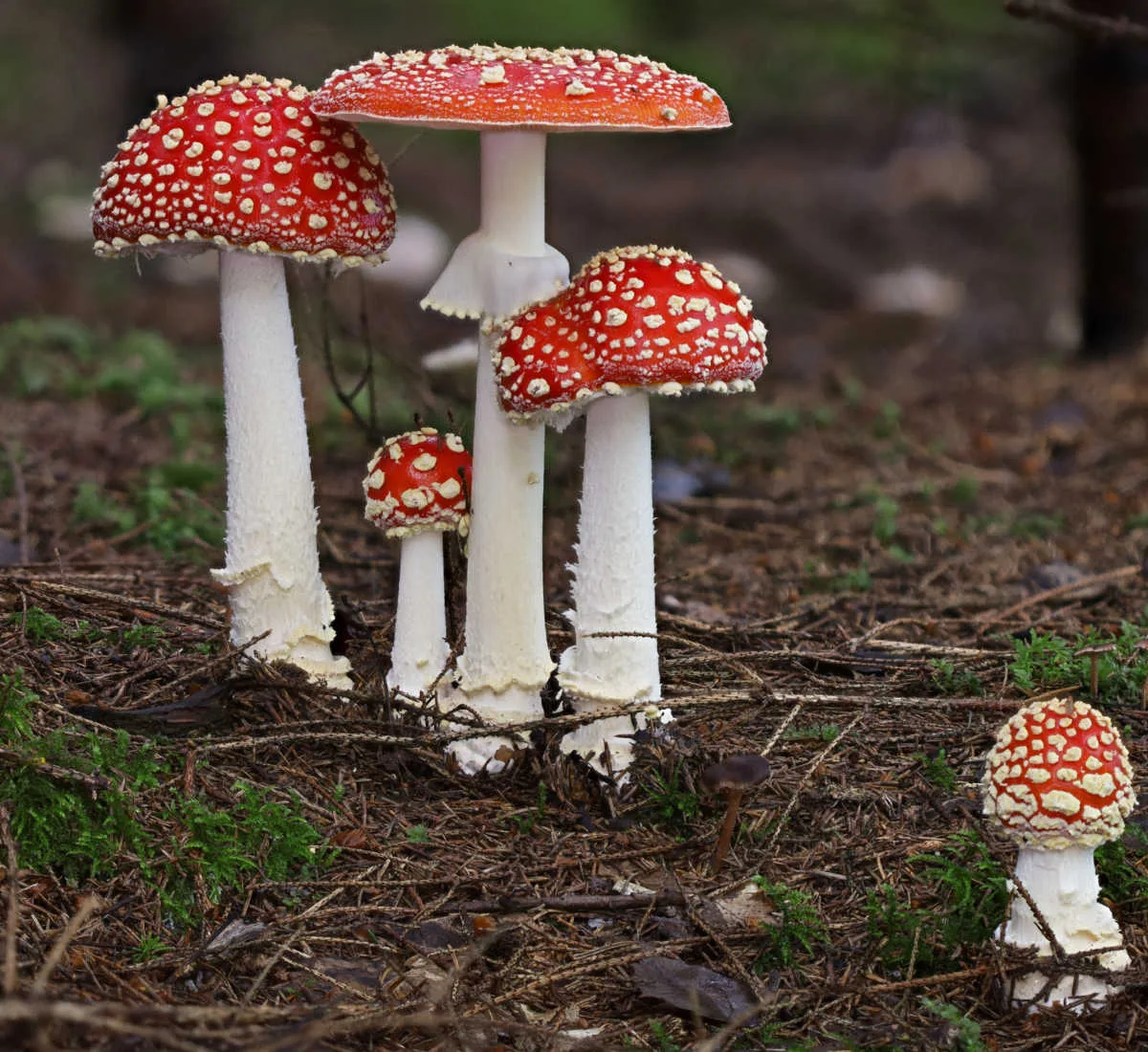
Amanita Muscaria (Fly Agaric) Liquid Culture Syringe is a sterile syringe filled with nutrient solution containing living fungal tissue (mycelium) of the iconic red-and-white mushroom scientifically known as Amanita muscaria.
Unlike spore syringes, which contain microscopic spores that must germinate before growth begins, a liquid culture syringe contains actively growing mycelium suspended in a sugar-based solution (often light malt extract or similar carbohydrates). In theory, this allows faster colonization when introduced into a suitable environment.
However, Amanita muscaria is fundamentally different from common cultivated mushrooms like Pleurotus ostreatus or Hericium erinaceus. It is a mycorrhizal species, meaning it forms a symbiotic relationship with living trees rather than growing independently on dead organic matter.
This biological requirement makes Amanita muscaria extremely difficult to cultivate indoors.
What Is Amanita Muscaria Liquid Culture Used For?
One of the most searched questions online is what an Amanita muscaria liquid culture syringe is actually used for.
Unlike saprophytic mushrooms (which grow on wood, straw, or compost), Amanita muscaria:
-
Forms symbiotic relationships with trees
-
Requires living roots to thrive
-
Cannot be reliably grown on grain or sawdust alone
Therefore, liquid culture is generally used for:
1. Research Purposes
Mycology labs study mycorrhizal fungi and tree-fungal symbiosis.
2. Experimental Inoculation of Trees
Some growers attempt to inoculate tree seedlings (birch, pine, spruce) to establish mycorrhizal partnerships.
3. Educational Study
Understanding fungal biology and forest ecosystems.
It is not typically used for standard indoor mushroom cultivation.
Can You Grow Amanita Muscaria From Liquid Culture?
This is one of the most frequently searched questions.
The honest answer: It is extremely difficult and rarely successful indoors.
Amanita muscaria requires:
-
Living tree roots
-
Specific soil conditions
-
Natural environmental cycles
-
Seasonal temperature changes
Unlike oyster mushrooms or king oysters, it cannot be grown on sterilized grain and fruit reliably indoors.
Some researchers attempt to inoculate:
-
Birch trees
-
Pine trees
-
Spruce trees
Even then, fruiting may take years—if it occurs at all.
Is Amanita Muscaria Liquid Culture Better Than Spores?
For mycorrhizal fungi, both spores and liquid culture face major limitations.
Liquid Culture Advantages:
-
Contains live mycelium
-
May establish symbiosis faster
-
Potentially more predictable genetics
Spore Advantages:
-
Easier to store long term
-
More natural method for outdoor inoculation
In practical terms, neither guarantees successful fruiting.
Why Is Amanita Muscaria So Hard to Cultivate?
Amanita muscaria is not a saprophytic mushroom. It is mycorrhizal, meaning it forms a mutualistic relationship with plant roots.
The fungus:
-
Exchanges nutrients with trees
-
Receives sugars from the plant
-
Helps trees absorb minerals
Without a living host tree, it cannot complete its natural life cycle.
This is the primary reason why liquid culture does not function like it does for gourmet mushrooms.
What Trees Does Amanita Muscaria Grow With?
Amanita muscaria commonly associates with:
-
Birch
-
Pine
-
Spruce
-
Fir
These symbiotic relationships occur naturally in temperate and boreal forests.
Any attempt to use liquid culture would typically involve inoculating soil near compatible tree roots.
How Do You Use Amanita Muscaria Liquid Culture?
If used experimentally, it would involve:
-
Selecting a compatible tree seedling
-
Preparing non-sterile but suitable soil
-
Injecting liquid culture near the root system
-
Allowing long-term colonization
Even then, fruiting may take 2–5 years, if it occurs at all.
It is not suitable for grain spawn production like common cultivated mushrooms.
Is Amanita Muscaria Liquid Culture Legal?
Legality varies depending on jurisdiction.
In many U.S. states, Amanita muscaria is not federally scheduled. However:
-
Laws differ by state
-
Some local restrictions may apply
-
Regulations can change
Always verify current local and state laws before purchasing, possessing, or attempting cultivation.
What Does Healthy Amanita Muscaria Mycelium Look Like?
In laboratory conditions, Amanita muscaria mycelium typically appears:
-
White
-
Fine and thread-like
-
Slow-growing compared to oyster species
It does not exhibit the aggressive, dense growth patterns of fast-growing gourmet mushrooms.
How Do You Store Amanita Muscaria Liquid Culture?
If maintained for research purposes:
-
Store at 35–45°F
-
Avoid freezing
-
Use within 2–3 months for best viability
Because mycorrhizal fungi are sensitive, viability may decrease faster than typical gourmet species.
Can Amanita Muscaria Liquid Culture Go Bad?
Yes.
Signs of contamination include:
-
Cloudy or milky solution
-
Sour smell
-
Unusual colors (green, black, pink)
-
Slimy consistency
Due to slow growth, contamination can easily outcompete Amanita mycelium.
Does Amanita Muscaria Fruit Indoors?
This is one of the most common Google searches.
No reliable indoor fruiting method currently exists for Amanita muscaria.
Unlike mushrooms such as:
-
Oyster
-
Lion’s Mane
-
King Oyster
Amanita muscaria requires outdoor forest-like conditions and symbiosis with trees.
Commercial indoor production is not currently practical.
How Long Does It Take Amanita Muscaria to Fruit?
In nature, fruiting occurs:
-
During fall
-
After sufficient rainfall
-
When temperatures cool
If inoculating a tree, fruiting could take years—if it happens at all.
There is no predictable timeline.
Can Beginners Use Amanita Muscaria Liquid Culture?
It is not recommended for beginners.
Reasons:
-
Extremely difficult cultivation
-
Requires tree symbiosis
-
No reliable indoor method
-
Long time frames
-
High failure rate
Beginners interested in mushroom growing should start with saprophytic species instead.
What Is the Difference Between Amanita Muscaria Liquid Culture and Agar?
Liquid Culture:
-
Used for expanding living mycelium
-
Difficult to maintain due to slow growth
Agar:
-
Better for observing contamination
-
Preferred for research and strain isolation
Most mycological research begins on agar before expanding culture.
Why Do People Search for Amanita Muscaria Liquid Culture?
Interest is often driven by:
-
The mushroom’s iconic red-and-white appearance
-
Cultural folklore
-
Historical references
-
Curiosity about cultivation
However, cultivation reality differs significantly from common assumptions.
What Makes Amanita Muscaria Unique?
Amanita muscaria is unique because:
-
It is mycorrhizal
-
It has a long ecological history
-
It appears in folklore and art
-
It forms complex forest symbiosis
Its biology makes it fascinating but extremely challenging to cultivate artificially.
Can You Make Amanita Muscaria Liquid Culture at Home?
In laboratory settings, mycelium can be transferred into nutrient solution under sterile conditions. However:
-
Growth is slow
-
Contamination risk is high
-
Practical cultivation benefit is limited
It is generally done for research, not production.
Is Amanita Muscaria Worth Attempting to Grow?
For scientific curiosity or ecological study, perhaps.
For practical mushroom cultivation, it is not recommended due to:
-
Symbiotic tree requirements
-
Long timelines
-
Low predictability
-
Lack of reliable indoor fruiting
Growers seeking reliable harvests typically choose saprophytic gourmet species.
Be the first to review “Amanita Muscaria (Fly Agaric) Liquid Culture Syringe (10cc)”
Related products
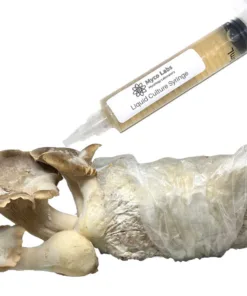
psilocybin mushroom spore syringe
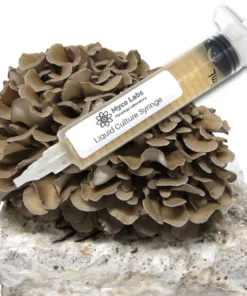
psilocybin mushroom spore syringe
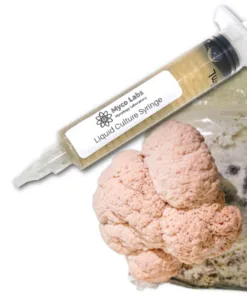
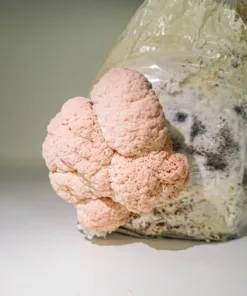
psilocybin mushroom spore syringe
Lion’s Mane Liquid Culture Syringe – Isolated Pink Variety (10cc)
psilocybin mushroom spore syringe
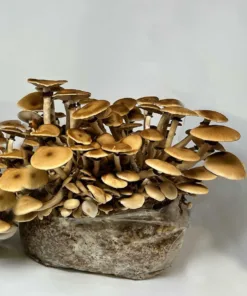
psilocybin mushroom spore syringe
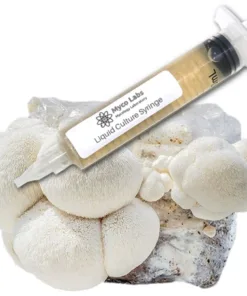

psilocybin mushroom spore syringe
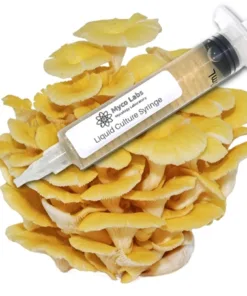

psilocybin mushroom spore syringe
Mushroom Spore Syringe
Reviews
There are no reviews yet.